When to Appeal an SC Family Court Ruling (and Why You Usually Shouldn't)
- October 9, 2026
- ByAngela Elliott Frazier
Your custody hearing didn't go the way you expected. The judge issued an unfavorable ruling, and you're already looking to get your case in front of someone else who will look at the facts and see it your way.
Here's the hard truth we tell our clients before helping them pursue appeals: An appeal isn’t a new trial in front of a new judge, and it's rarely the fastest, cheapest, or best path forward.
As experienced Greenville family law attorneys, we've had this conversation with plenty of clients who were convinced that the judge simply got it wrong. Sometimes they're right, and an appeal is the appropriate move. More often, though, the reality is that an appeal will cost tens of thousands of dollars, take a year or more, and very likely fail.
In this article, we explain how family court appeals work in South Carolina, why the deck is stacked against the party seeking to reverse a ruling, and how to tell the difference between a case worth appealing and one worth letting go.
No, You Don't Get a New Judge
This is the single biggest misconception we run into.
An appeal to the South Carolina Court of Appeals isn’t a new trial. No one re-hears your testimony, re-evaluates your credibility, or weighs novel evidence. The appellate court simply reviews the written record from the original case — the transcript, the exhibits, and the final order. If you didn't say it or introduce it at trial, the Court of Appeals will never see it.
The panel of appellate judges is asking one narrow question: Did the family court judge make a legal error or reach a conclusion that the evidence in the record doesn't support? They aren’t asking whether they personally would have ruled the same way.
That subtle difference in purpose is why so many appeals fail even when the losing party is genuinely convinced that the outcome was unfair.
#cta_start
Not Sure If Your Case Is Appeal-Worthy?
Before you commit thousands of dollars to an appeal, get an honest assessment of your odds. We'll go through the court order and trial record with you and tell you straight whether an appeal is a fight worth pursuing.
#cta_end
The Standard That Decides Appeals
South Carolina's appellate courts give family court judges wide latitude, and for good reason. Family court judges sat in the room. They watched you and your ex-spouse testify, weighed body language and credibility in real time, and heard every witness before making a ruling.
The appellate judges weren't there. For this reason, they start every case with the presumption that the trial judge acted within their broad discretion on judgment calls like property division, custody, and support.
To win a reversal, you generally have to show one of two things: that the judge misapplied the law, or that the ruling rests on findings that the record simply doesn't back up. Courts describe this as an "abuse of discretion", and it’s intentionally a demanding standard.
It isn’t enough to show that a different judge, hearing the same facts, might have split the marital estate 55/45 instead of 60/40 or granted you two more overnights a month. The Court of Appeals won't second-guess a reasonable call just because a better one existed.
That said, reversals do happen periodically. In one 2006 case, the Court of Appeals overturned a 70/30 division of a marital estate after finding that the family court gave undue weight to an expert's irrelevant testimony and penalized one spouse too harshly for marital misconduct.
But notice the actual mechanism of reversal in this example: a specific, identifiable legal error, not general disagreement with the outcome.
What the Appeals Process Looks Like
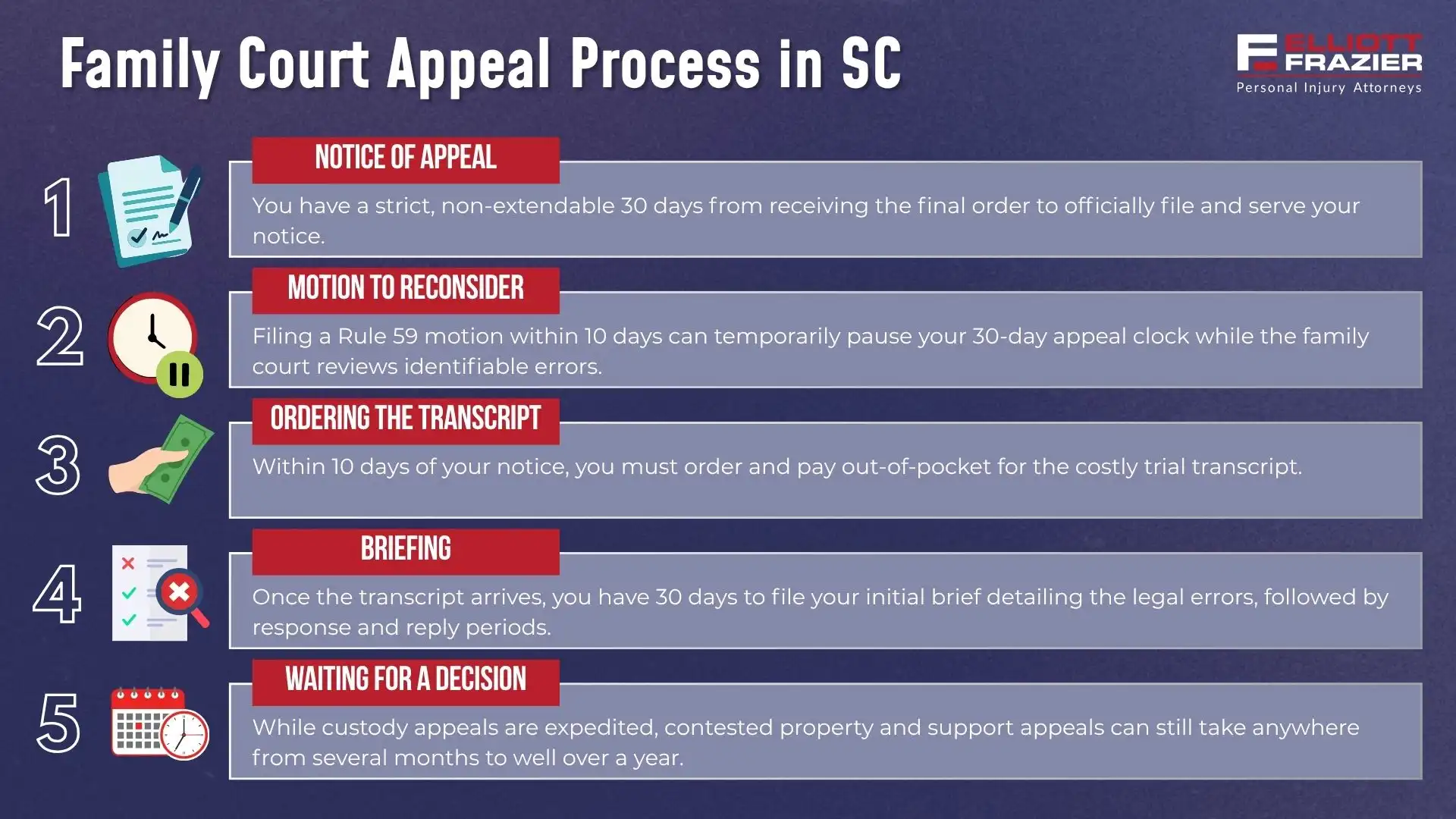
If you do decide to move forward with an appeal, it’s important to understand how the timeline will play out. Here’s a general overview.
Notice of Appeal
You have 30 days from receiving written notice of the final order to file and serve your notice of appeal. This deadline can’t be extended, and missing it will put an end to your appeal before it ever starts.
Motion to Alter or Amend a Judgment (Optional)
If the judge overlooked a particular issue or made an identifiable error, a motion to alter or amend a judgment can pause the 30-day appeal clock while the family court takes another look. This motion must be filed within 20 days after the original order is entered.
Ordering of Trial Transcript
For domestic actions, you must request the trial transcript within 10 days of submitting your notice of appeal, and you're responsible for paying for it. The trial transcript can cost hundreds or even thousands of dollars before you've even filed your first brief.
Briefing
Once the transcript arrives, you have 30 days to file your initial brief laying out the specific legal errors you're challenging. The other party then gets 30 days to respond before you get a final chance to reply.
Decision
Most appeals decisions take several months to a year or more. Custody and visitation appeals are supposed to move on an expedited timetable under a 2022 Supreme Court order, but contested property and support appeals can still stretch well past a year.
Throughout all of this, the original order will remain in effect. If the judge awarded your ex-spouse custody or ordered you to pay alimony, you must continue following that order during the entire appeals process unless you separately ask for and receive a stay. An appeal doesn’t put your life on hold while you await a ruling.
When an Appeal Makes Sense
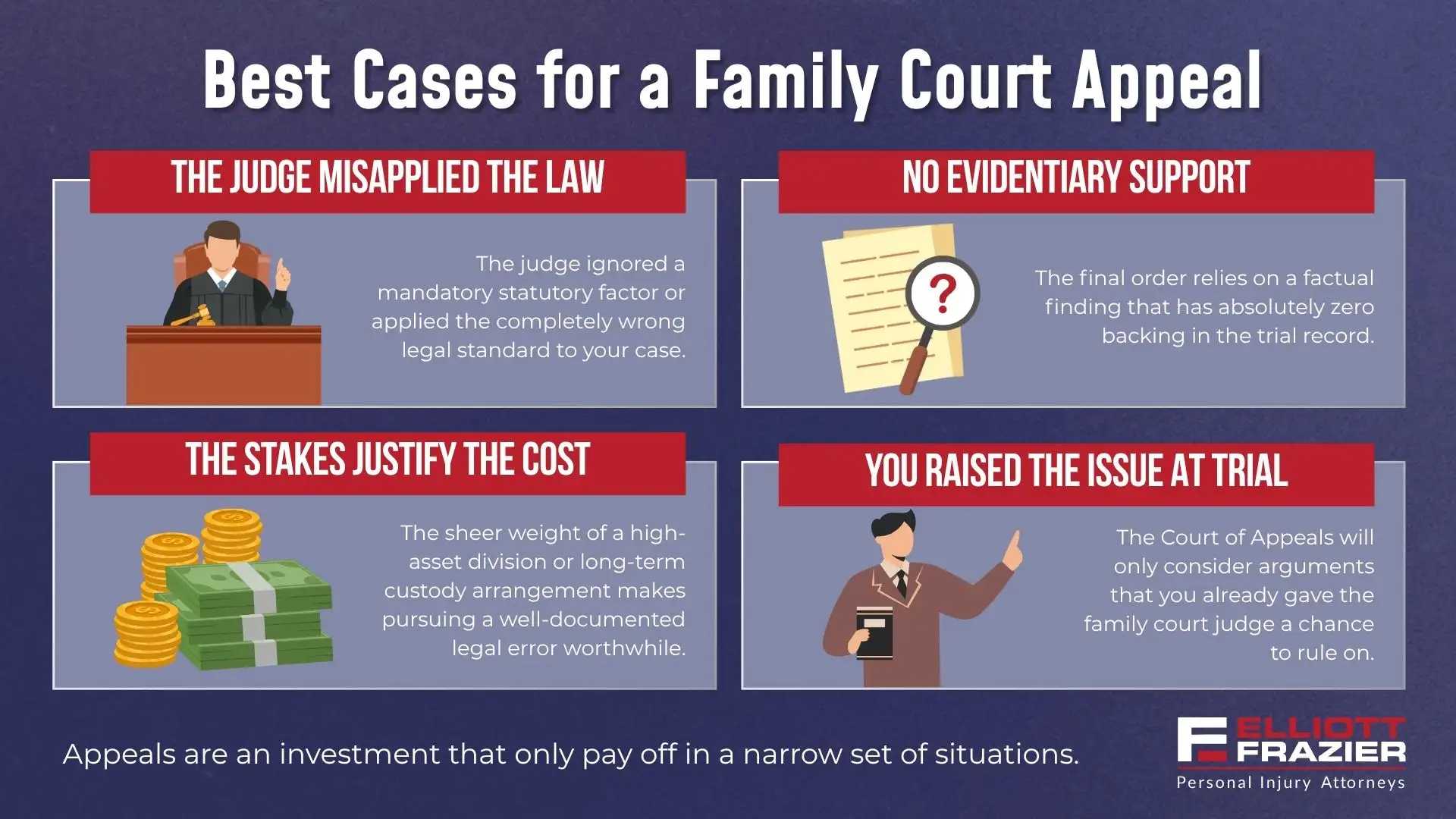
South Carolina family court appeals really only warrant the cost in a narrow set of circumstances, including the following:
- The judge misapplied the law: That may mean ignoring statutory factors in a property division or custody determination, or applying the wrong legal standard altogether.
- The ruling has no evidentiary support: The order issued relies on a factual finding that doesn’t reflect the contents of the trial record.
- The stakes justify the cost: A high-asset divorce or long-term custody arrangement may carry enough weight to make pursuing an appeal worth the difficulty and cost.
- You already raised the issue at trial: The Court of Appeals generally won't consider an argument you never gave the family court judge a chance to rule on first.
That being said, appealing generally isn’t worth it if one or more of the following are true:
- You simply don't like the outcome: Disagreeing with a judge's decision doesn’t mean a legal error has been made, even if the result feels unjust.
- The time or expense isn’t warranted: Appeals can take months and cost thousands once the costs are all added up, and that’s on top of what you’ve already spent at trial.
- You need a faster resolution: If you’re looking to change a custody or support order, a modification action in family court is usually a more direct and less expensive path.
If you’re unsure whether you should go to the trouble of appealing a South Carolina family court case, a consultation with a knowledgeable attorney can point you in the right direction.
Get Your Questions Answered — Turn To Elliott Frazier Family Law
Deciding whether to appeal a family court ruling is as much a practical decision as it is a legal one. The right answer depends on what specifically went wrong in your case, what the trial record shows, and whether the monetary and time commitment is worth it given what's at stake.
The seasoned attorneys at Elliott Frazier Family Law won't tell you what you want to hear just to take on another case. We'll review the court order and trial record with you, give you a candid assessment of your odds, and help you decide whether an appeal, a motion to alter or amend a judgment, or a modification action is the best recourse. Schedule a consultation today.
FAQs
#faq_start
Can I appeal a family court decision and get a different judge to hear my case fresh?
No. An appeal is a review of the written record from your original trial, not a new hearing. The Court of Appeals doesn't hear new testimony or reassess credibility; it only looks at whether the family court judge made a legal error or reached a conclusion the record doesn't support.
How long do I have to appeal a family court order in South Carolina?
You generally have 30 days from the date you receive written notice of the final order to file and serve your notice of appeal. This deadline is strict and generally can’t be extended, so if you're considering an appeal, don't wait to talk to an attorney.
Will my custody or support order change while the appeal is pending?
Not automatically. The original order will remain in effect while your appeal moves through the legal process unless you separately request and are granted a stay. Support obligations, in particular, generally continue to accrue during appeal.
What's the difference between an appeal and asking the judge to reconsider?
A motion to alter or amend a judgment asks the same family court judge to correct a specific error or address an issue they overlooked, and it must be filed within 10 days of the order.
An appeal, meanwhile, goes to a different court entirely and asks appellate judges to review the record for legal mistakes. Many attorneys file a motion to alter or amend a judgment first when there's a clear, fixable issue.
How much does a family court appeal cost in South Carolina?
Costs vary considerably depending on the length of the trial record and the complexity of the issues at hand, but appeals routinely add thousands of dollars to what’s already been spent on the underlying case once transcript fees, briefing, and attorney time are factored in.
For more context on typical family court costs, refer to our guide on how much a divorce costs in South Carolina.
If I don't appeal, do I lose my other options?
Not necessarily. If your circumstances have genuinely changed since the order (for example, a job loss, relocation, or a change affecting your child's well-being), a modification action in family court will likely offer a faster and less costly route than an appeal, and it doesn't require proving that the original judge made a legal error.
.png)
.avif)
Angela Elliott Frazier
Angela Elliott Frazier protects and represents individuals facing personal injury challenges in South Carolina. She is committed to standing up for her clients' rights and guiding them through the legal process.
Get an Honest Evaluation Before You Commit
We'd rather tell clients honestly that an appeal isn't worth it than take a case we don't believe in. To figure out your next steps, you need a legal team that’s been through the process time and time again.