Equitable Distribution in SC: Why "Fair" Doesn't Always Mean 50/50
- October 6, 2026
- ByAngela Elliott Frazier
One of the first questions people ask when their marriage ends is a simple one: Does my spouse automatically get half of everything? In South Carolina, the answer is no, and that single fact changes nearly every financial decision you make from here forward.
South Carolina is not a community property state. Our family courts divide marital assets through a process called equitable distribution, and the word that matters most in that phrase is equitable, not equal. The judge’s job is to reach a fair outcome, and what “fair” looks like depends on what you contributed to the marriage, what you sacrificed, and in some cases, how the marriage ended.
As Greenville divorce attorneys, we’ve walked many clients through this exact framework. Below, we break down how equitable distribution works in South Carolina, what counts as marital property, and the specific factors a family court judge considers when splitting your estate.
Is South Carolina a 50/50 Divorce State?
No. South Carolina is an equitable distribution state, not a community property state.
In community property states like California and Texas, courts generally split marital assets straight down the middle. South Carolina rejects that approach. Instead, S.C. Code Ann. § 20-3-620 directs family court judges to divide marital property fairly, based on the unique circumstances of each marriage.
Practically speaking, that means the final split can look like 50/50, but it can just as easily be 60/40, 70/30, or, in rare cases, even further apart. The percentage depends on what each spouse brought to the marriage and what the court considers just.
What Is Equitable Distribution in Divorce
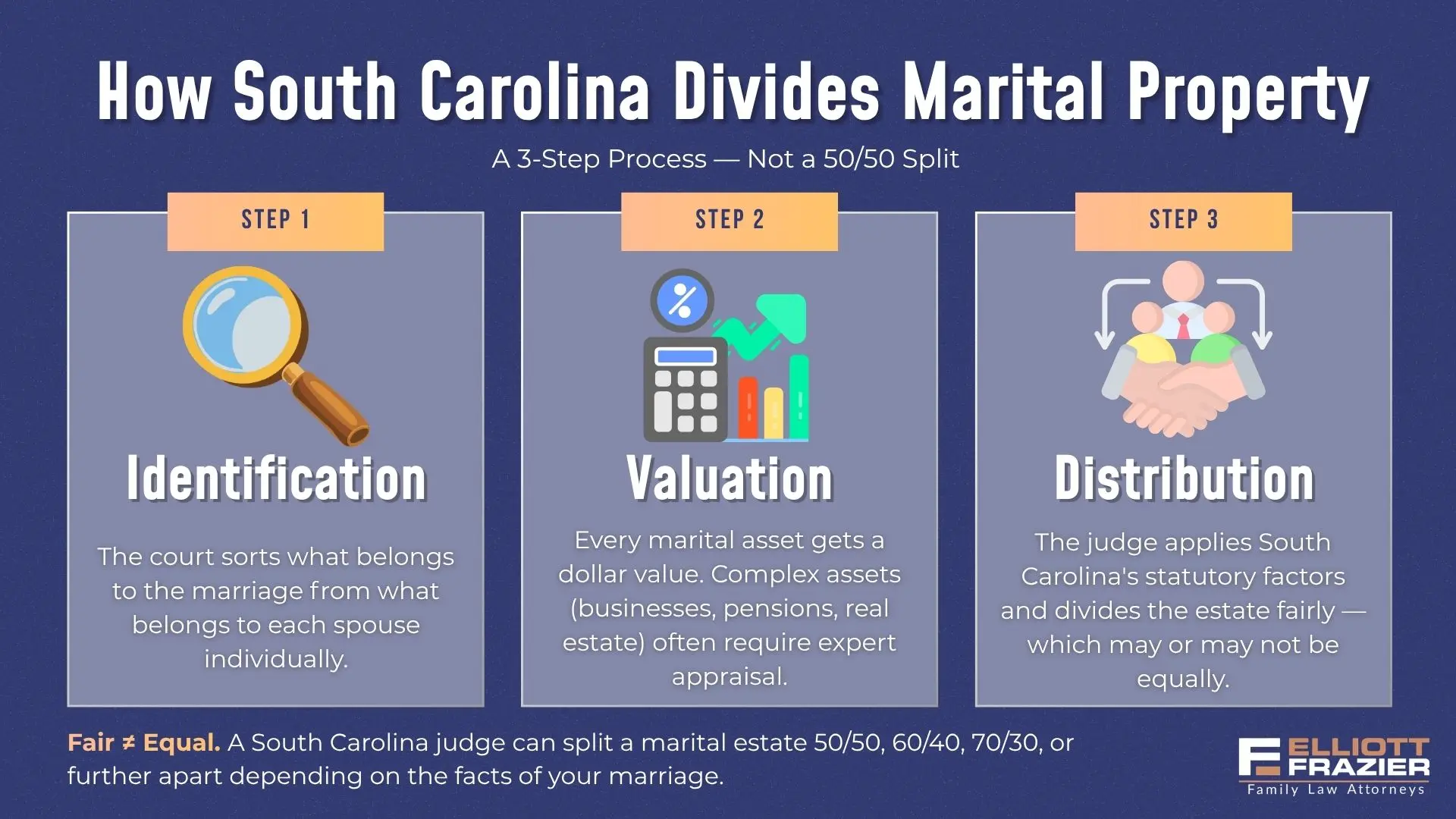
Equitable distribution is the legal process South Carolina family courts use to divide everything a couple acquired during the marriage. It happens in three distinct stages, and each stage matters for the final outcome:
- Identification. The court (with help from both attorneys) identifies which assets and debts belong to the marriage and which belong to one spouse individually.
- Valuation. Each marital asset is assigned a dollar value. For straightforward items like a bank account, this is easy. For a closely held business, a pension, or real estate, valuation often requires expert analysis.
- Distribution. The judge applies South Carolina’s statutory factors and decides how to fairly divide the marital estate between the spouses.
Each step builds on the last. A mistake during identification (for example, mislabeling a marital asset as separate property) can shift tens of thousands of dollars away from where it should land.
Marital Property vs. Separate Property in South Carolina
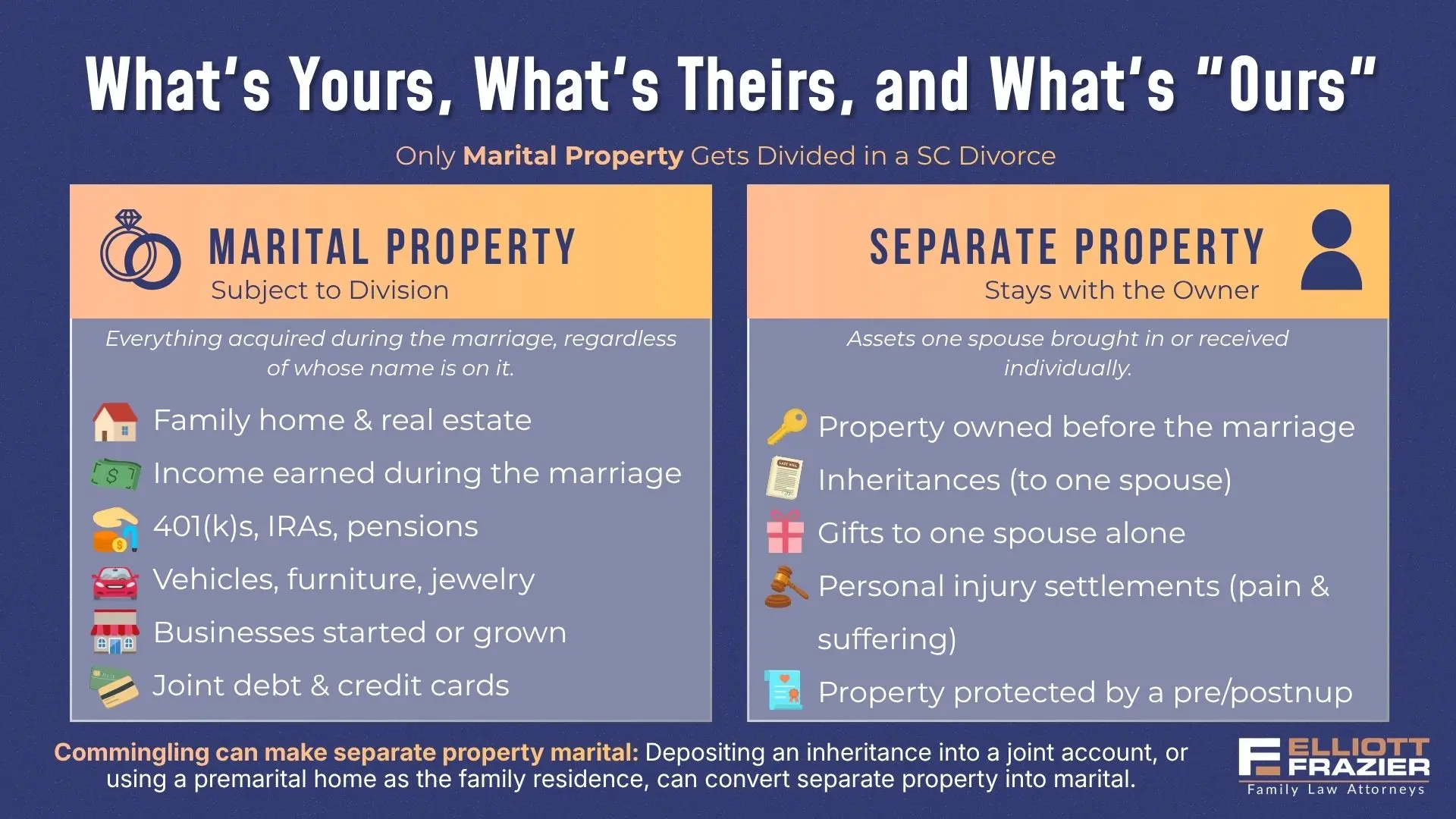
Before anything is divided, the court must draw a line between marital and separate property. Only marital property is subject to equitable distribution. Separate property belongs to the spouse who owns it and stays with them after the divorce.
What Counts as Marital Property
Marital property generally includes everything either spouse acquired during the marriage, no matter whose name is on the title or account. Common examples are:
- The family home and any other real estate purchased during the marriage;
- Income earned by either spouse during the marriage;
- Retirement accounts, 401(k)s, pensions, and IRAs accrued during the marriage;
- Vehicles, furniture, jewelry, and other personal property acquired together;
- Businesses started or grown during the marriage;
- Investment and brokerage accounts opened or funded during the marriage;
- Debt taken on during the marriage, including credit cards, mortgages, and loans.
What Counts as Separate Property
Separate property includes assets that one spouse brought into the marriage or received individually. Common examples are:
- Property owned by one spouse before the marriage;
- Inheritances received by one spouse, even during the marriage;
- Gifts given to one spouse alone (not to the couple jointly);
- Personal injury settlements for pain and suffering of one spouse;
- Property explicitly designated as separate in a valid prenuptial or postnuptial agreement.
Where It Gets Complicated: Commingling and Transmutation
Separate property does not always stay separate. If you deposit an inheritance into a joint checking account, use a premarital home as the family residence, or rely on your spouse’s income to maintain a separate asset, you may have “transmuted” it into marital property without realizing it.
South Carolina courts look closely at how separate assets were treated during the marriage. Tracing those funds back to their original source typically requires meticulous financial records and, sometimes, a forensic accountant. This is one of the most contested areas of any high-asset divorce.
#cta_start
Worried About Losing What You’ve Built?
A fair equitable distribution starts with thorough preparation. Our Greenville divorce attorneys help you accurately identify, value, and protect every dollar of your marital estate, so a fair outcome is also a strategic one.
#cta_end
Factors a South Carolina Court Considers
Once the court knows what’s in the marital pot, S.C. Code Ann. § 20-3-620(B) sets out factors the judge must consider before deciding who gets what. There is no formula. The judge weighs each factor based on the specific facts of your marriage.
- Duration of the marriage. Longer marriages typically lead to a more even division, since lives and finances are more deeply intertwined.
- Marital misconduct or fault. Adultery, dissipation of marital funds, or reckless destruction of assets can shift the division of marital assets in favor of the innocent spouse.
- Each spouse's financial contributions. Who earned what, who paid the mortgage, and who funded retirement accounts during the marriage.
- Non-financial contributions. South Carolina explicitly recognizes homemaking, child-rearing, and career support as real contributions to the marriage.
- Income and earning potential. A significant earning gap between spouses can lead to a larger share of liquid assets going to the lower-earning spouse.
- Health, age, and physical condition. Older spouses or those unable to return to full-time work may receive more to ensure long-term stability.
- Tax consequences. $100,000 in a retirement account is not the same as $100,000 in cash. The court considers after-tax value.
- Existing support obligations. Child support or alimony from a prior relationship factors into how much each spouse can absorb.
- Non-marital property already held. If one spouse owns significant separate property, the other may receive a larger share of marital assets to balance the picture.
- Custody of minor children. The primary custodial parent often receives the family home, at least until the children reach a certain age.
How to Protect Your Financial Future

Equitable distribution is fact-driven, which means preparation directly affects your outcome. A few practical steps make a significant difference:
- Gather your financial documents early. Tax returns, bank statements, retirement account summaries, mortgage records, and business financials all become evidence.
- Trace your separate property. If you brought assets into the marriage or received an inheritance, document the source and how it was kept.
- Avoid commingling further. Don’t move separate funds into joint accounts once a divorce is contemplated.
- Don’t hide or transfer assets. South Carolina courts take asset dissipation seriously, and the consequences usually outweigh any benefit a spouse might gain from hiding property.
- Get a clear valuation. For businesses, real estate, retirement accounts, and complex investments, accurate valuation is the foundation of a fair division.
Get Your Questions Answered with Elliott Frazier Family Law
Equitable distribution is one of the most consequential parts of any South Carolina divorce, and it's also one of the easiest places to lose ground if you go in unprepared. The difference between a fair outcome and a costly one usually comes down to how well your assets are identified, valued, and presented to the court.
At Elliott Frazier Family Law, we approach property division the way it should be approached, as a major financial transition, not just a legal dispute. With an MBA-trained managing attorney, deep experience in high-asset cases, and a team that genuinely cares about the family on the other side of the file, we help you protect what you've built and step into your next chapter on solid ground.
Whether your divorce involves a straightforward split, a closely held business, retirement accounts that require careful tracing, or a contested estate with fault at issue, we have a strategy that fits your situation. Schedule a consultation today.
FAQs
#faq_start
Is my spouse automatically entitled to exactly half of everything I own?
No. South Carolina is an equitable distribution state, not a 50/50 community property state. Only marital property is subject to division, and even then, the court divides it fairly based on the statutory factors, not automatically in half. Your separate property generally stays with you.
Does adultery affect property division in South Carolina?
It can. South Carolina courts may consider marital misconduct, including adultery, when dividing the marital estate, especially if marital funds were used to support the affair. Adultery does not automatically forfeit a spouse’s share of property, but it is one of the factors a judge can weigh.
How is a business divided in a South Carolina divorce?
If the business was started or grew during the marriage, it is typically considered marital property, even if only one spouse runs it. The court will order a professional valuation, then decide on a fair division, which often means awarding the business to the operating spouse and giving the other spouse offsetting assets of equal value.
What happens to the family home?
The home is usually marital property, regardless of which spouse is on the deed. The court may award it to one spouse outright, order it sold and the proceeds divided, or allow one spouse (often the primary custodial parent) to remain in it for a defined period before sale.
How long does equitable distribution take?
In an uncontested divorce where both spouses already agree on how to divide assets, distribution can be finalized along with the rest of the divorce. In contested or high-asset cases involving valuations, tracing, or business interests, the process can take many months to over a year. The more complex the estate, the more time is typically needed to get it right.
Can a prenuptial agreement override equitable distribution?
Yes, in most cases. A valid, properly drafted prenuptial or postnuptial agreement can define what is separate property, what is marital property, and how assets will be divided. South Carolina courts generally enforce these agreements as long as they were entered into voluntarily, with full disclosure, and are not unconscionable.
#faq_end
.png)
.avif)
Angela Elliott Frazier
Angela Elliott Frazier represents clients in South Carolina in divorce, custody, alimony, and other family law matters. She provides clear guidance and steady support so her clients can make informed decisions during difficult times.
Get Strategic, Financially Sharp Representation
With an MBA-trained managing attorney and a team experienced in high-asset divorce, our firm approaches your case as it should be: as a major financial transition that will shape the next chapter of your life.